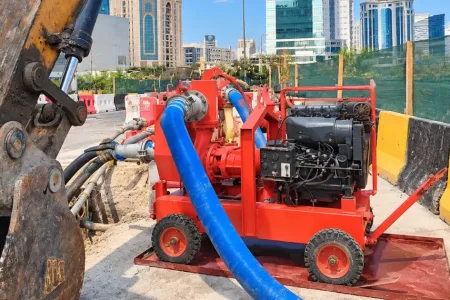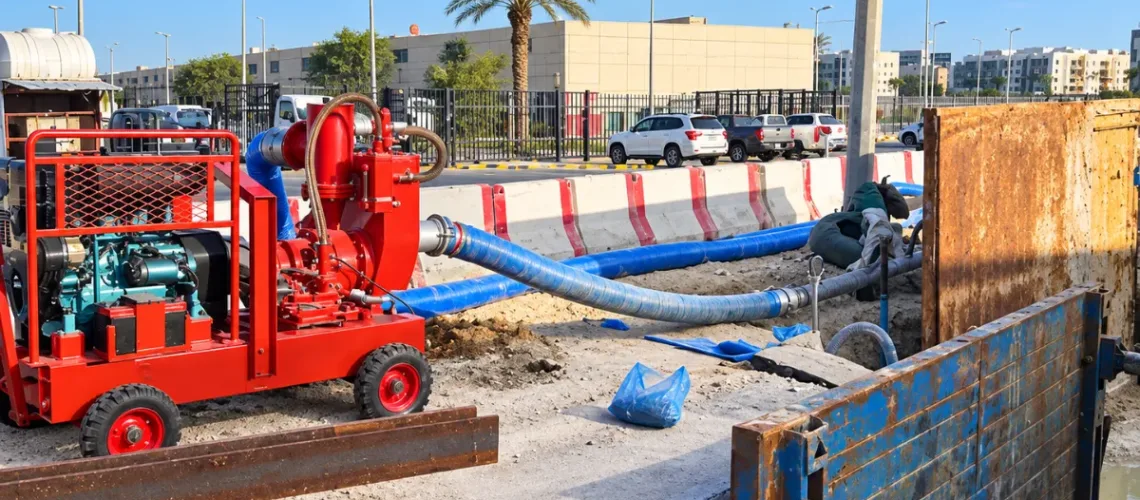
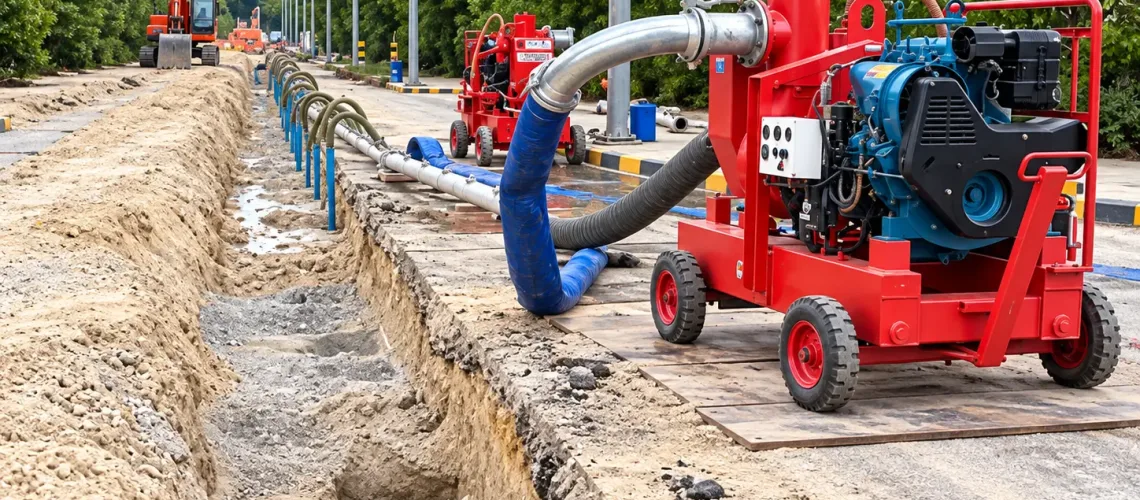
Water can quickly become a major problem on a construction site. Excavations may fill with groundwater, trenches can collect rainwater, foundations may become difficult to work in, and underground projects can slow down when water is not properly controlled. This is where dewatering pumps come in. A dewatering pump removes unwanted water from a work area and transfers it to a suitable discharge location. Depending on the site, the solution may involve a simple pump in a sump or a complete groundwater-control system using wellpoints, header pipes and vacuum-assisted pumps. For construction and infrastructure projects across the UAE, Oman and Bahrain, choosing the correct dewatering system can help keep excavations workable, reduce interruptions and support safer site operations.
A dewatering pump is a pump used to remove groundwater, rainwater or accumulated site water from excavations, trenches, foundations, pits and other areas where water interferes with construction or industrial work.
The pump collects or draws water from the required area and transfers it through a discharge hose or pipeline to an approved discharge point.
Dewatering pumps are widely used in: Construction, Groundwater control, Excavation works, Piling and foundation projects, Mining and quarrying, Pipeline projects, Municipal works, Flood control, Drainage Industrial sites
Water Source → Pump → Discharge Line → Safe Discharge Point
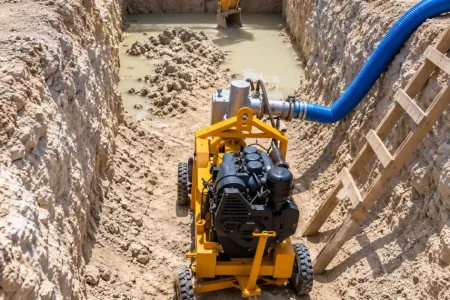
A surface dewatering pump normally draws water through a suction hose and transfers it through the discharge side.
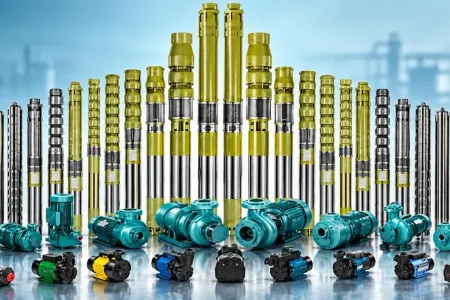
A submersible pump works differently. The pump itself is placed directly inside the water and pushes the water through its discharge line.
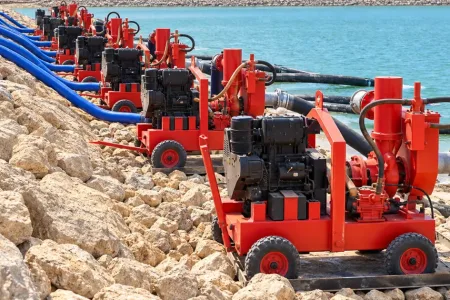
In more advanced groundwater-control systems, several wellpoints may collect groundwater and connect to a common header pipe, which then connects to the dewatering pump.
This is why the pump is only one part of a complete dewatering setup.
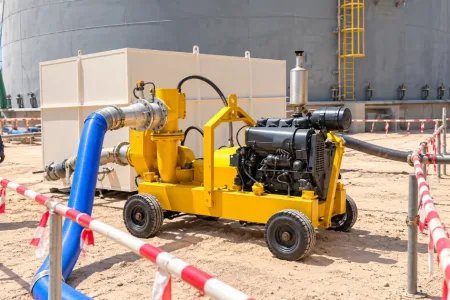
Self-priming centrifugal pumps are widely used for construction dewatering and general water transfer.
These pumps are normally positioned above ground and connected to a suction hose.
They are suitable for applications requiring:
High water flow
Construction-site drainage
Groundwater transfer
Excavation dewatering
Floodwater removal
Temporary pumping
Diesel-driven models are especially useful on sites where electrical power is limited or unavailable.
Vacuum-assisted pumps combine a centrifugal pump with a priming system that helps remove air from the suction line.
They are particularly useful for groundwater-control applications where reliable priming and continuous suction performance are important.
These pumps are commonly associated with:
Wellpoint dewatering
Groundwater lowering
Construction excavation
Pipeline projects
Foundation works
This is one of the most common points of confusion for beginners. A pump type refers to the equipment doing the pumping. A dewatering method refers to how groundwater is collected and controlled on the site. For example, a vacuum-assisted centrifugal pump may be used as part of a wellpoint dewatering system. Common dewatering methods include: Sump Dewatering Water is allowed to collect in a pit or sump and is then pumped away. This is one of the simplest methods for shallow water accumulation. Wellpoint Dewatering Multiple small wellpoints are installed around the excavation and connected to a header pipe. A suitable dewatering pump creates suction and helps lower the groundwater level around the work area. Deep-Well Dewatering Deep wells equipped with suitable submersible pumps are used where greater groundwater drawdown is required. Eductor Systems Eductor systems may be considered where soil conditions and required drawdown make conventional wellpoint methods less suitable.
Choosing the right pump starts with the site condition, not simply the pump size.
Flow tells you how much water the pump needs to move.
It is commonly expressed in:
m³/h — cubic metres per hour
L/s — litres per second
A project with large groundwater inflow may require significantly more capacity than a small trench drainage job.
Head describes the pressure or energy the pump needs to move water through the system.
It includes factors such as:
Vertical lifting height
Discharge distance
Pipeline resistance
Hose losses
Fittings and bends
A pump with high flow but insufficient head may not deliver the required performance.
Groundwater conditions, coastal development, excavation work, infrastructure construction and temporary drainage requirements create regular demand for pumping systems across the Gulf. For projects in the UAE, Oman and Bahrain, pump selection should also consider practical operating conditions such as high ambient temperatures, dust, long operating hours, equipment access, noise restrictions and spare-parts availability. A residential construction project may require a quieter configuration, while a remote infrastructure site may prioritize mobility, fuel capacity and continuous operation. The correct solution should always be matched to the site.
If you are not sure what dewatering pump you need, start with these six details:
Water quantity → Required head → Water condition → Excavation depth → Power availability → Project location
With these details, a pump supplier can understand the requirement much more accurately.
TARIS supplies dewatering pumps, pump sets, industrial pumps, heavy equipment, engines, valves, fittings, spare parts, gensets, building materials and other industrial products.
Yes. TARIS supports dewatering requirements with pump sets, header pipes, wellpoints, fittings, couplings, spare parts and related accessories, along with sales, rentals and service support.
TARIS supplies and sources dewatering pumps, submersible pumps, sewage pumps, portable pumps, centrifugal pumps, diesel pump sets, electric pump sets, high-head pumps and other application-specific pumps.
Yes. TARIS supports selected heavy equipment and project machinery requirements including gensets, tower lights, forklifts and other suitable industrial equipment.
Yes. TARIS is based in the UAE and supports customers and projects across Oman and Bahrain.
Yes. Customers can send the product specification, model, datasheet, BOQ or reference image for sourcing assistance.