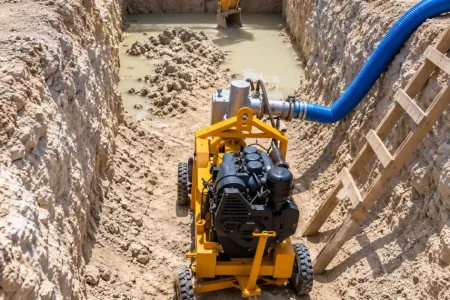
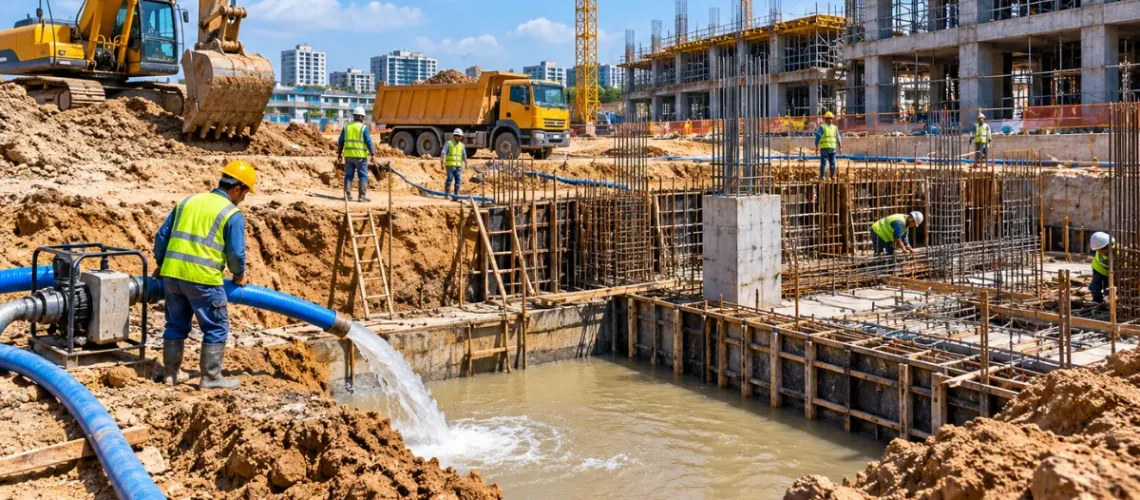
Imagine a construction site where excavation has started for a foundation or basement. After reaching a certain depth, groundwater begins entering the excavation continuously. The work area becomes wet, soil starts softening, and excavation progress slows down.
Simply pumping out the visible water may not solve the problem if groundwater keeps entering from the surrounding soil. In this situation, the site needs a planned construction dewatering solution rather than only an emergency water pump.
Pump size should not be selected only by suction and discharge diameter.
A 6 inch pump from one model may perform very differently from another 6 inch pump. The better approach is to check the required flow rate and total head first.
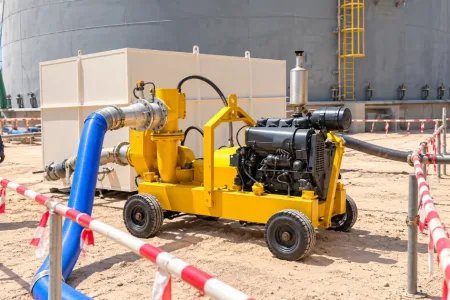
If the site requires large-volume pumping, a larger pump may be suitable. For smaller pits or temporary drainage, a compact pump may be enough.
First, check where the water is entering from, how quickly it is accumulating, excavation depth and the approximate groundwater level.
The main question is whether the site has temporary surface water or continuous groundwater inflow. This determines the dewatering method.
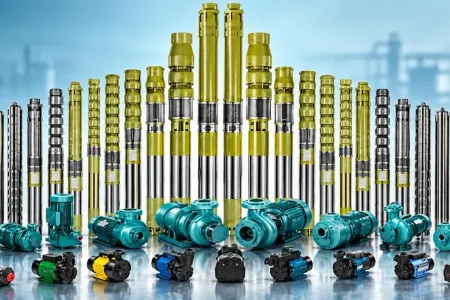
For a shallow excavation where water collects in one area, sump dewatering with a suitable submersible or dewatering pump may be enough.
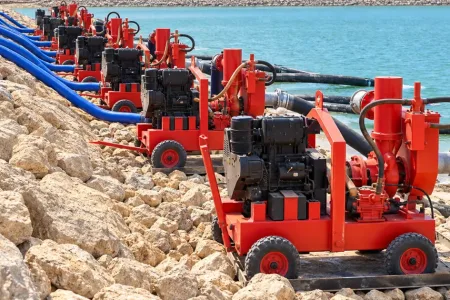
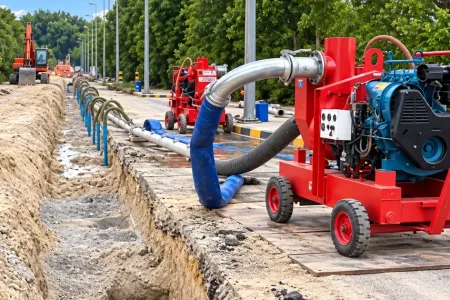
If groundwater continuously enters around the excavation, a wellpoint dewatering system may be more suitable. Multiple wellpoints can be installed around the work area and connected to a header pipe and suitable vacuum-assisted dewatering pump.
For deeper groundwater-control requirements, a deep-well system may need to be considered.
Step 3: Select the Pump by Duty
Do not select the pump only by saying “6 inch” or “8 inch.”
Check the required:
Flow → Head → Suction Depth → Water Condition → Operating Hours → Discharge Distance
These details help identify whether the project needs a surface dewatering pump, submersible pump or another pumping arrangement.
A working dewatering setup may also require suction hoses, layflat discharge hoses, strainers, couplings, fittings, header pipes, wellpoints and sedimentation tanks.
All components should match the pump and site conditions.
Step 5: Keep the System Running
Once installed, monitor the water level, suction connections, hoses, strainers and pump performance regularly. If groundwater remains controlled and the excavation stays workable, construction can continue with fewer interruptions.
The objective of dewatering is not simply to “pump water out.”
It is to control groundwater sufficiently so excavation, foundation and construction work can continue under manageable site conditions.
TARIS supports dewatering pumps, wellpoint equipment, hoses, fittings and related groundwater-control requirements for construction projects.


 by